Showing posts with label Birds. Show all posts

Thursday, August 4, 2016

In April 2016, we arrived at our new home near the village of Prospect, Nova Scotia, after 19 long hrs on the road. It was 10:30 pm and the night was clear with a dark sky full of stars. A Northern Saw-Whet owl's calls greeted us and a Great-horned owl call was heard soon after. To me, these owl calls were an omen of good things to come, that this was indeed a very special place.

This has proven to be true, it is a magical location, 4 acres of maritime coastal forest with a small spruce bog and a barrens area, fronting on a small freshwater lake joined by a creek to the ocean. The ocean is a 5-minute walk away along a wooded trail. I am thankful that the lake is too small for motorized watercraft and only 4 houses are on it's shore. 
Barachois Lake 


The lakefront has been left natural with only a deer trail giving us access to swim or kayak. The songs of the White-throated Sparrow and Hermit Thrush are heard at dawn and these are the last bird songs we hear at nightfall. 
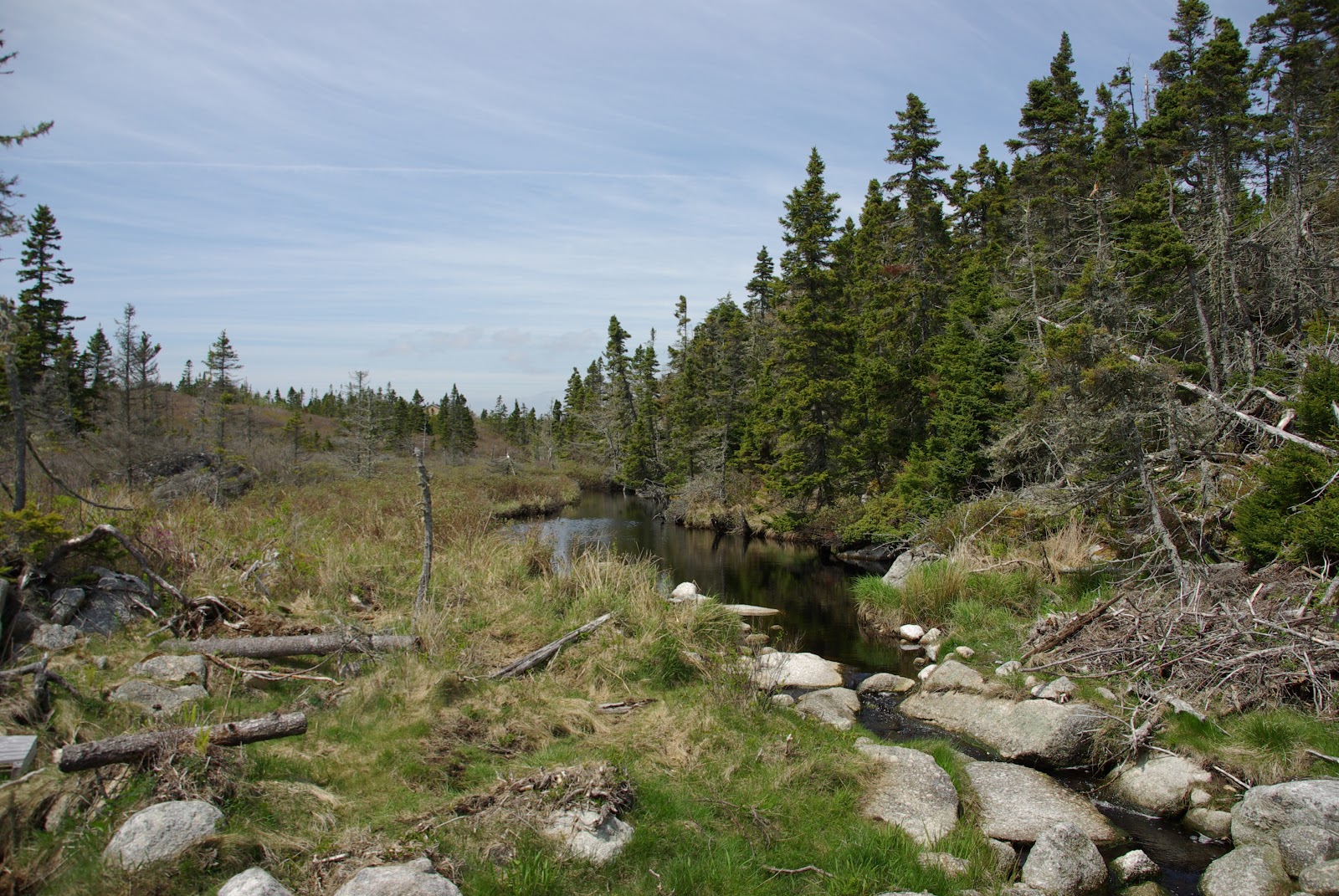
Creek flowing to ocean


Ocean front


As I write this, a Bald Eagle in 3rd year plumage has landed on a nearby tree and is being harassed by a pair of Ospreys. A raft of 11 Black Ducks are voicing their displeasure but the Eagle is ignoring them. Instead he hops into the shallows and proceeds to bathe. I've observed a daily ritual of bathing by dozens of Double-crested Cormorants and a few Herring and Great Black-backed Gulls. They fly in, land on the water then proceed to bathe, shaking off, then flying out. Being next to the ocean, this is a handy place to get the salt off their feathers. 

An adult Bald Eagle and a Herring Gull have also arrived and a pair of Ravens are circling overhead. High up a female Northern Harrier is rising on the thermals. The woods around the house are full of young birds, mostly Yellow-rumpled Warblers, Palm warblers, Purple Finches, Blue Jays, Red-Breasted Nuthatch, Juncos, White-throated Sparrows, Song Sparrows, Hairy Woodpeckers and Northern Flickers. These species likely nested here or nearby as the adults sang or were seen here since spring. Two young crows are following their parents while begging for food. 

It has been so exciting to learn about this beautiful province and see the progression of the seasons and the various species of flowering plants, mosses and trees. There is something new to discover every day. I hope to share these on my blog so you can learn along with me.


Enjoy the warm summer days.

Sunday, February 2, 2014

Northern Saw-whet Owl story ends badly

Today, I heard from my friend Audrey that someone had dropped off an injured Saw-whet Owl that was seen being harassed by crows.  She thought the owl had a head injury, possibly from a collision. There was no bleeding or obvious trauma to the head except an abnormal skewed head position. The wings were fine and it was able to fly a few feet but was somewhat thin. At the advice of the Owl Foundation she only gave the owl water until transport to their facility. 

I was called by the Foundation to help in transporting the owl as my spouse and I have volunteered to help out as drivers. There was quite a snowfall last night so it was agreed that we would bring the owl to the Toronto Wildlife Centre, which is closer, saving us a few hours on the road. I prepared a box for transport.

Northern Saw-whet owl so tiny he fits in one hand
Sadly when we arrived to pick up the owl, Audrey announced that it had just died. She held the still soft body for us to see. It is not often that we get to see these wee owls up close. It was heart wrenching to see this sad little body, a life cut short. Most people don't even know these tiny magnificent creatures exist. Saw-whet owls are 18-23 cm tall with a wingspan of 43-55 cm. They are small but mighty hunters taking whatever they can,  be it a bird, a vole, a mouse etc.. Hard to believe it had survived the harsh winter up to now.


The Saw-whet sadly didn't survive
Normally injured owls are taken to the Owl Foundation in Vineland but on occasion the Foundation will arrange to have the owl taken to the Toronto Wildlife Centre where it can receive emergency care. If an owl requires specialized care or a longer rehab it is then transferred to the Owl Foundation. Injured wildlife should always be cared for in a licensed rehabilitation centre.

Both these agencies operate on donations and with the help of many volunteers; the staff are caring and well trained,  so it you have a soft spot for injured owls or any other wildlife please support these wonderful agencies by visiting their websites and making a donation. www.theowlfoundation.ca   
www.torontowildlifecentre.com

 During winter when food is scarce, Owls often perch on fenceposts or top of hydro poles during the daytime, near roadsides scanning for prey. This makes them vulnerable to collisions with cars. If you do see an owl, admire it from a distance, do not disturb it as trying to find food in winter conditions is difficult enough without us interfering. Many fail to find enough food to survive. Enjoy it’s magnificence from a distance.

Louise

Thursday, November 24, 2011

Autumn lingers


Watching the news makes one realize how winter has unofficially arrived in many parts of Canada with snowy blustery days and even major snowstorms. The closest we’ve come is one night of freezing rain which coated everything but luckily the ice melted by noon the next day. Now the warmer weather has returned and with it fog follows the cooler nights. In the morning the ground is covered in frost before the sun melts it. I love how the grasses and fallen leaves are outlined in ice crystals.
This morning, the sun was shining on one side of the yard and there I found a Periwinkle flower.
Blue Bell still blooming.


White fluffy Milkweed seeds were caught in groundcover.
By contrast, in the shaded parts of the yard, the green foliage, grasses and fallen leaves were covered in a frosty coating; each leaf veins and hairs outlined in rime creating exquisite patterns.


When the leaves are down it’s a good time to examine trees and shrubs for nests and cavities which are so well camouflaged in the summer. There are discoveries to be made such as the now easily seen pendulous Baltimore Oriole nests hanging towards the end of sturdy twigs; I found 3 of these marvels in the yard.  
Baltimore Oriole nest in Birch


 I love birch trees, the tiny twigs and seeds creating stark shadows on the white bark.


Even the weedy brown Mulleins stalks stand tall looking a bit like skinny Saguaro cacti. The birds love to perch on these vantage points in the summer, to catch passing insects on the fly. Now they serve to remind me of those warmer days. I will clean the yard up in the spring but for now I leave all undisturbed, places for winter species to hide and feed during the harsh winter months.
Louise
Mullein stalks

Saturday, November 12, 2011

Preventing Bird Window Collisions

Each year countless birds die as a result of collisions with windows or reflective glass. New windows in particular are very reflective so a bird will only see the outdoors, perhaps the sky or trees, reflected back and it will keep flying right into the glass thinking it has a clear path ahead. The resulting injury is usually immediately fatal or permanent (fractures, head or eye injuries) and even if the bird flies off apparently uninjured, it may perch somewhere, disoriented, and die later of a slow bleed or shock or fall prey to a cat or other predator.

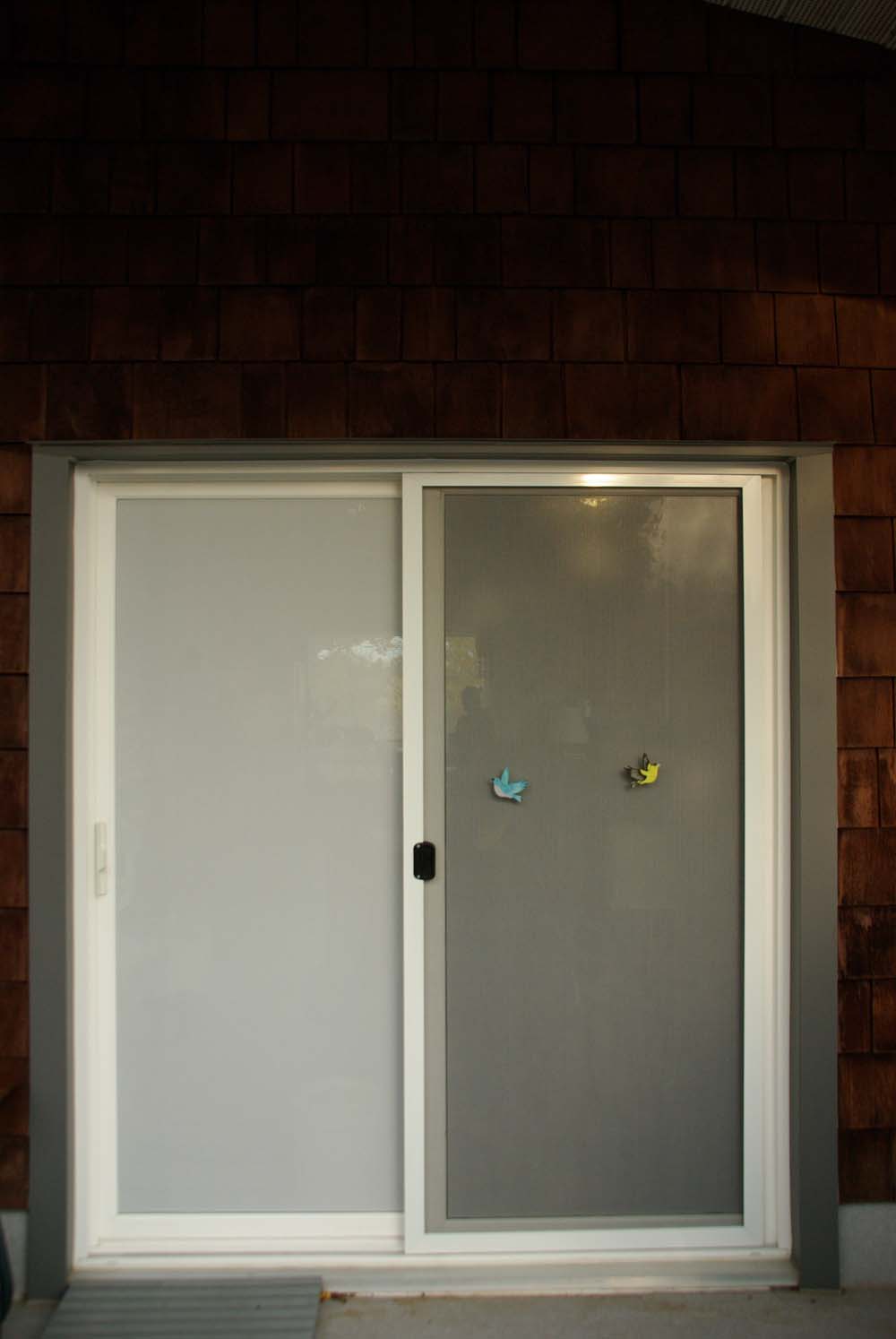
I recently installed a window film called CollidEscape on the outside of a patio door, to stop birds from trying to fly through the house. I found out about this product from the Fatal Light Awareness Project (FLAP) newsletter.
FLAP is a non-profit group started by a group of dedicated volunteers who pick up injured or dead migrating birds from the base of high-rise buildings in downtown Toronto. The birds that recover are released outside the city. It has evolved into a very effective organization dedicated to stopping the deaths of birds hitting reflective glass or lit buildings at night. They have helped with establishing changes in building codes and are now in a legal battle with the owners of one particularly deadly building. Their work has brought attention to the plight of our migrating songbirds and similar projects have started in other major cities in North America. If you care about the fate of millions of migrating birds, please go to the FLAP website and get informed. http://www.flap.org/
After installing this window film, the results are quite dramatic and effective from the outside and do not impede our view at all. The first photo shows our view through the film from the inside; it's like looking through a regular screen. The other photo shows the view from the outside. It almost looks like a solid white window, giving privacy. It allows the sun to shine in and the view but the birds no longer try to fly in.


The cost was $130 for two patio door panels which came in 2 rolls. I cut them to size before installing so that I have enough leftover to do a couple windows.  The life of even one bird saved is worth it for me. I ordered directly from this website http://collidescape.ca/ .
The customer service was excellent, I ordered the patio door set and there is plenty of material and it is easy to cut to whatever size you need. It's worth checking out this site if you have a troublesome window or door in your house. There are also other ways of reducing window collisions described in the FLAP website so please check it out.
Louise

Monday, October 31, 2011

Owl Release!

GOOD NEWS! Out of the blue I received a call from my friend Audrey, to tell me that the injured Barred Owl that we delivered to the Owl Foundation Rehabilitation Centre in Niagara Falls last February was recovered and fit for release. The past news about this owl was that it had a permanent vision impairment and was unreleasable. They monitored and reassessed it and determined the vision was fine. I was ecstatic to hear this young owl would have a chance at life in the wild!


Another trip in a cardboard box

On Saturday October 29, two volunteers transported the owl from Niagara to Port Hope in a cardboard box, where it was picked up by Emily, the young woman who had initially found the injured owl in a field near her home in the country. Audrey and I, and some members of Emily’s family joined her at the site where she found the owl. The idea is to release it where it was found since it will know the territory and find food and shelter easily and it might even have a mate around the area.
The location was good, a hay field adjacent to a wooded hill with a marsh and pond at the base of the hill. The whole area is rolling hills with open fields and woodlots with mixed deciduous and fir trees.
The box was positioned not too close to the tree line, to allow the owl to gain height when flying out. It was feisty and trying to get out of the box before it was opened. Once the lid was off, it hesitated looking at us in confusion for a second before exploding out of the box in a flurry of feathers.
 It flew effortlessly over the field and into the woods, disappearing from site within seconds. Immediately, a flock of Blue Jays could be heard harassing the poor owl. A predator in their midst! Soon the jays moved a bit further away until only one was still calling. We assumed the owl must have moved off deeper into the woods to get away from the mob.

Free at last


It was cloudy and cool with the odd drizzle but this week calls for warmer and sunnier weather so hopefully the owl will get his bearings back, resume hunting successfully and find some good roosts before winter settles in. Ultimately it might find a mate and be nesting come February and rear future generations of owls. All we can do is hope.
Even though owls face many challenges, this one has a chance at life again, the journey so far has been bumpy but for now it continues on a good path and for that I am grateful.
Louise

Thursday, April 28, 2011

Easter in Nova Scotia

It’s been such a long time since my last entry, spring has arrived, migrants are returning, a favorite time of year. Flowers and buds are emerging from a long winter’s sleep and the spring peepers are in full song. How I love to smell the sweet earthy scent and feel the warm sun on my face. I lay in the slowly greening grass the other day and just took it all in, the big sky, the awakening earth, the revival.
I’ve been busy planning a big road trip out west for June and in the interim, we decided on an Easter visit with my daughter and her partner living in Halifax. We left on Wednesday before Easter, in warm rainy weather in Ontario only to drive through the worst winter storm a few hours later. It started with freezing rain east of Montreal, then sleet, then blowing snow. Treacherous driving conditions and of course we had just removed the snow tires off the car. Spring in Canada!


We overnighted in Riviere-du-Loup, Quebec. No chance to see Beluga’s at the harbor this time as the storm raged on. It snowed all night and into the next day as we traversed New Brunswick. By Nova Scotia the weather cleared, virtually no snow there and by the time we reached Halifax, it felt like spring again. We had wonderfully sunny days over Easter weekend, a bit cool on the coast but fantastic for hiking.

As I write this, the fog is rolling in from the sea, a light drizzle falling, fog horns sounding, it’s been like this for 3 days. A typical Nova Scotia day on the coast. We are fortunate to be staying in a delightfully small coastal community called Duncan’s Cove.

Duncan's Cove

From our bed we can see and hear the ocean.

"Rusty" the Pheasant and his mate

We are house sitting in a light-filled home a stone’s throw from the ocean, in a tiny harbor. The house is surrounded by forest so we have been seeing plenty of wildlife: rabbits, White-tailed deer, Porcupine, Squirrels, several bird species including White-throated sparrows and Song sparrows singing all day long, robins, crows, gulls, chickadees, juncos, mourning doves, Goldfinches and our favorite, a pair of Pheasants. The male with his striking plumage always comes first making sure the coast is clear for his mate, a very well camouflaged hen. She blends right into the landscape. We have named the male “Rusty” because of his plumage and raucous calls, which we hear several times a day with some drumming.
We’ve hiked the surrounding coastal trails with family and ate some great foods.
Remnants of the war

There are several abandoned remnants of WWII bunkers on the coast which we explored during our hikes. One has a house built right on top.

house built on top of WWII bunker

We’ve also had several sightings of Eider Ducks, Bald Eagles and Black Guillemots and one of harbor seals lazing on nearby rocks.

Harbour seals

I love hearing the waves crashing and pounding on shore and especially the sound of boulders rolling around with the waves. The result is stones and boulders of all sizes worn smooth by the wave action.
This is our last day here, so even though it is damp, foggy and windy we will hike one last time and enjoy a seafood dinner tonight. I will post more on beautiful Nova Scotia later.
Cheers,
Louise

Tuesday, March 1, 2011

Rescued Barred Owl Update

I thought that those of you who read my entry on the injured Barred Owl that we transported to a Rehabilitation Centre might be interested in the outcome so far.
The young male owl was examined by an opthalmologist who discovered some serious damage. It appears that his right eye is blind and will not recover. The left eye also shows residual issues from trauma, including cataracts. So for now he will continue on eye meds and stay indoors. Sadly it appears unlikely that he will return to the wild.
On a positive note he has gained weight from 502gms to 750gms so he is eating well and has settled in.
Louise

Sunday, February 27, 2011

Signs of spring


Today a tiny head poked up above the snow, the first chipmunk of the year! A sure sign that spring is on its way. Soon the Red-winged blackbirds will arrive with their raucous song, the males arriving first, flashing their red epaulets at other males, making their territorial claims.


The chipmunk purveyed the area, keeping an eye out for predators. He appeared very reluctant to leave the safety of the burrow. He first ventured up a nearby tree, then after an hour he scooted across the snowy yard to an abandoned groundhog burrow under a rock.
From there he watched the activity at the bird feeder, then maybe deciding it was still too cold, he retreated back to the comfort of his winter den. Even the peanuts I scattered on the ground could not entice him to come under the feeders. When you’re at the bottom of the food chain, you’re very cautious.
Several Dark-eyed juncos, another visitor from the northern woods, have spent the winter feeding in our yard and this morning I heard their trilling song, another sign of spring.

Dark-eyed Juncos
The Blue Jays have also started what is called “courtship feeding” where the male will bring food to a potential mate and delicately place it in her beak. It is so endearing to watch a pair sitting on a branch with the female coyly waiting for the offering. It’s comical to see how helpless the female can make herself appear.

Sumac


There is still plenty of winter food around the yard and species such as the Common Crows and Enropean Starlings have been eating this bounty in order to survive.
rosehips

High-bush cranberries

Soon vernal pools will appear when the snow melts. These are the ephemeral pools of water that dry up by summer but where many of our insects and amphibians start their lives. More on this later.
The snow has been slowly melting, warmer days and cool nights will soon have the maple sap running. My mouth is watering thinking about this truly Canadian sugary treat.  Nothing beats the taste of precious maple syrup on freshly made crepes. Mmmm…bring on spring!
Louise