Showing posts with label Sky. Show all posts

Wednesday, January 29, 2014

Every season has it’s beauty

The deep freeze is upon us; chilly winds, snow squalls and endless snowdrifts. All this on top of the ice storm that left at least one inch of hard ice under the snow. I pity the owls, hawks, foxes, deer…really all wildlife trying to find food in these hostile conditions. For humans, it’s business as usual, just open the fridge…imagine our ancestors and how difficult it was to stay alive.
Snow!

An icy coating on everything

It is comforting to know that in 6 or so weeks, Redwing Blackbirds will be returning from their southern digs, red epaulettes flashing against the blue sky, singing their raucous greetings. 

.In the meantime admire the changing scenery; snow sculpted by the wind, elongated purple shadows on white, iridescent sunrises, crimson sunsets…there is beauty everywhere!
Who said snow was white....


Late afternoon shadows


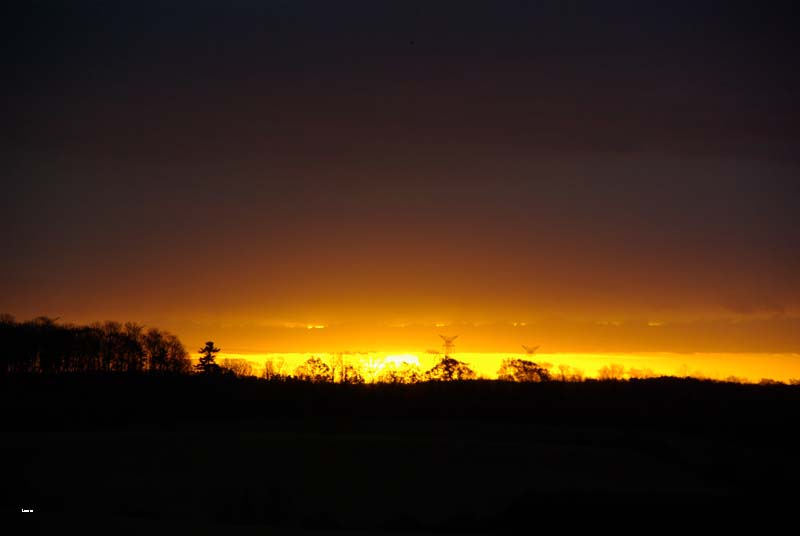
Winter Sunrise

Winter Sunset

Morning Sun halo
 Look beyond the salty sidewalks and you will see clouds dotting cerulean skies, sun halos and dark night skies with a generous sprinkling of diamond stars. 
 Sun halo, preceding a storm


Take a moment to breathe in the fresh crisp air and listen to the snow crunching underfoot. Dress for it and you will enjoy these moments. Each day is a gift, waiting to be unwrapped. Open it carefully, for it is special ...
Louise

Thursday, September 8, 2011

More fascinating insects!

There is definitely a smell of fall in the air, a spiciness, leaves are turning colours, the daylight hours are shorter and the nights are cooler. I always feel a little sad to see the end of summer, migrants leaving and songbird voices quiet. Sunsets are spectacular right now, something about the light gives more saturation to the red and pink hues.


I have a cast on my foot so have been doing a lot of sitting outside and it’s stunning to see the diversity of insects flying around, and in particular wasps; small parasitic wasps, those that hover, striped, plain, large, and even some bright green ones. Yes, they are at times annoying when food is around but if you ignore them or stay calm and gently shoo them away they are not aggressive and leave. Don’t panic and flail or swat or squeeze them as they might sting in self-defense, and you can’t blame them for that. I have never been stung and we have several species nesting near our deck. Insects are part of the web of life, we need them but they don’t need us, remember this.

Organ-pipe Mud Dauber nest

Some wasps are particularly nice to have around, take for instance the Organ-Pipe Mud Dauber Trypoxylon politum that has built a lovely nest on the cedar shake wall at the back of our house, near the roof, sheltered from the rain. It’s an architectural gem, really looking like organ pipes. I marvel at the design and the many trips carrying bits of mud the wasps must have taken to build it.  These wasps are large and black, are very docile and are not known to sting humans and best of all their main food source is spiders, which we have plenty of. I am pleased to have them living near us and helping keep our spider population in check.

  The Black Swallowtail caterpillars on my parsley survived to the last instar and then moved out to find a place to pupate. I have yet to find the pupae. 
Black Swallowtail last instar

   
Milkweed Tiger Moth

Yesterday I discovered 15 very pretty tufted moths on Common Milkweed plants in the front flower garden.

Milkweed

They are the larvae of the Milkweed Tiger Moth Euchaetes egle. They feed on Milkweed and Dogbane plants and like the Monarch Butterfly, the toxic chemicals from the milkweed are retained in the adult body. However instead of a visual warning of their unpalatability which would not be useful at night, the moths emit a click to deter bats from feeding on them. So much complexity!


Another exciting discovery was that of a large moth that looked like a piece of bark. I noticed it on the brick wall, it must have been disturbed from a hiding spot to end up in the open in the daytime. After some research, it was determined to be a nocturnal Bride Underwing Moth, Catopala neogama. The underwings were not showing but they would be a bright orange-red colour with black stripes. The moth was at least 2.5 inches long and 1.5 inches across and very convincingly looked like a piece of bark from a distance. The larvae feed at night on the leaves of Walnut or Hickory or Butternut and occasionally Oak tree species. We have a large Black Walnut tree near the house so perhaps it was the host tree. This morning the moth was gone, so I am lucky to have seen it.
If you are observant and curious, you will likely come across all sorts of interesting life forms and learn something new.
Louise


Monday, January 17, 2011

Big Sky Part II

Winter is a good time to watch the sky. Tiny ice crystals in the clouds refract and reflect sunlight which frequently results in lovely halos and sundogs. You can see these on days when the sun is shining and there are a few clouds about, especially thin cirrus clouds. I am not a scientist or an expert so for good information on atmospheric events please check out http://www.atoptics.co.uk/halosim.htm , it's well worth it.
You don't have to be anywhere special to see these, simply look at the sky and check out the areas around the sun but please never look directly at the sun, use your hand or other object to block it off. Also never look at the sun through binoculars, camera lens or telescope as it could easily damage your eyes instantly, so be safe!

The other day while a passenger in a car, I was treated to 2 large sundogs, which look like portions of rainbow on one or both sides of the sun, as above.

Other things to watch for from anywhere are early morning views of the sun or of the rising moon. The sun rises and sets every day and the moon appears every month, so just find a spot where you can watch. No need to spend thousands on a trip to sit and watch these events when they happen everywhere for free! I've enjoyed spectacular sunrises while a passenger on many commutes. Too often we miss enjoying the beauty of these everyday events because we are too busy...

 Misty sunrise.
Full moon.
A partially cloudy day offers another opportunity to see beauty in the sky.The sun's rays sneaking through the clouds make a magnificent spectacle.


Here is an atmospheric event most people are unaware of: seeing the earth's shadow at twilight. For this you need to have a pretty good view of the eastern horizon. As the sun sets, a darkish band rises on the eastern horizon. This is the shadow of the earth reflected on the atmosphere. To read more about this please check out this site:http://www.atoptics.co.uk/atoptics/earshad.htm . Lots of interesting stuff on that site.

Faint dark band at the horizon is earth's shadow at twilight.

The sky...ever changing...look up!
Louise

Tuesday, January 11, 2011

Big sky around us.

Since this is my first post, I thought I should tell you a bit about the special place where I live with my soul mate and various wildlife. The property is on the south slope of a large drumlin on the southern edge of the Oak Ridges Moraine. A drumlin is a deposit of sediment left by a glacier, so our soil is sandy with gravel, rocks and boulders. http://en.wikipedia.org/wiki/Drumlin

We are surrounded by hills and valleys with mostly hay fields, cattle pastures and woodlots. Our property is next to a regenerating meadow and a deciduous woodlot and beyond this is a large spruce and pine plantation. Our property itself has open grassy areas, loved by Eastern Bluebirds and Northern Flickers, interspersed with many trees and shrubs. There is a creek nearby and a couple miles north lies the Ganaraska Forest, a large tract of mixed forest.

Twelve miles south and below us is Lake Ontario, seen from our location on clear days. Because of our high elevation and lack of close neighbours except to the north, we have a mostly unobstructed view for miles to the south and south-east. I spend a lot of time watching the sky as it seems so big here. It is ever changing, with spectacular blazing sunrises, clouds and storms rushing by, each season bringing it's own beauty. Sunsets are more subdued, as we are below the rise of the drumlin to the west. I took these photos from our deck and they are untouched, colours are true.
Winter sunrise

Golden sunrise

Fall sunrise

Sunset (photo of the eastern sky)

Winter sky

Summer sky

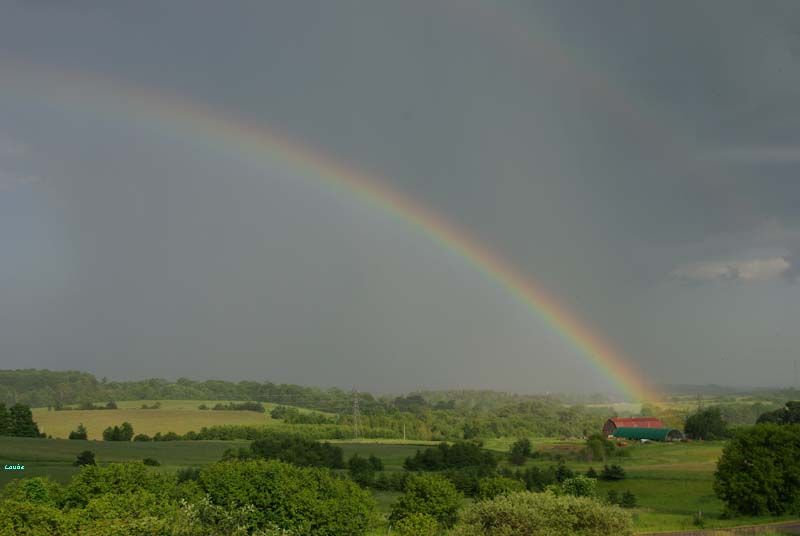
Double rainbows are common here
I hope you enjoy these photos as much as I enjoy these vistas.
Louise